

The technical side of my MiniMax H3 setup is covered in part 1 and part 2. This piece is about the other half, the half that actually decides whether any of it is useful: creative direction. How the basketball shot was briefed, designed and directed, and why the process matters more than the output.
Start from a brand, not from a fantasy
Most AI video demos put someone in a fantastic situation, a superhero landing, a Transformers-scale set piece, something built to look cool for 6 seconds. That proves the model can render spectacle, and proves nothing about whether it can do a job, because commercial work rarely asks for spectacle. It asks for a perfume in the right light, a jacket on the right body, a sports brand's attitude held consistently across a campaign.
So I set the test up the way a real brief would arrive. I imagined a sports brand whose colours are green and beige, with a dark, cinematic atmosphere to its world, and wrote myself a short brief from that: a one-on-one basketball play, one continuous handheld shot, everything on screen speaking the brand's palette and mood. No brief, no shot. The constraint is the point, because a model that can only impress when it is unconstrained is a toy, and the question I am testing is whether this one takes direction.
Design every element before generating a single frame of video
The shot was built the way a production would be, as separate designed elements that come together, rather than as one lucky prompt.
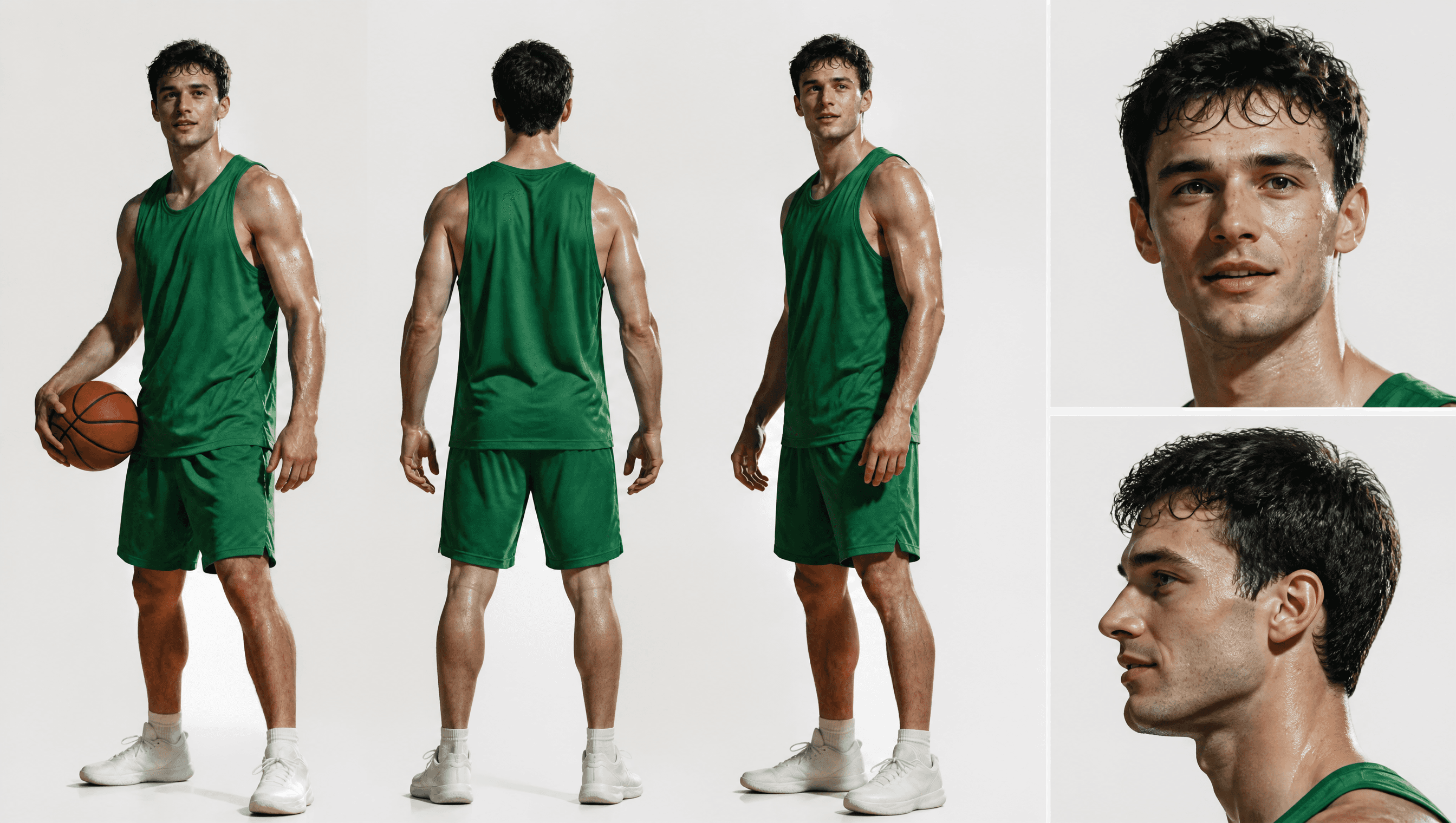
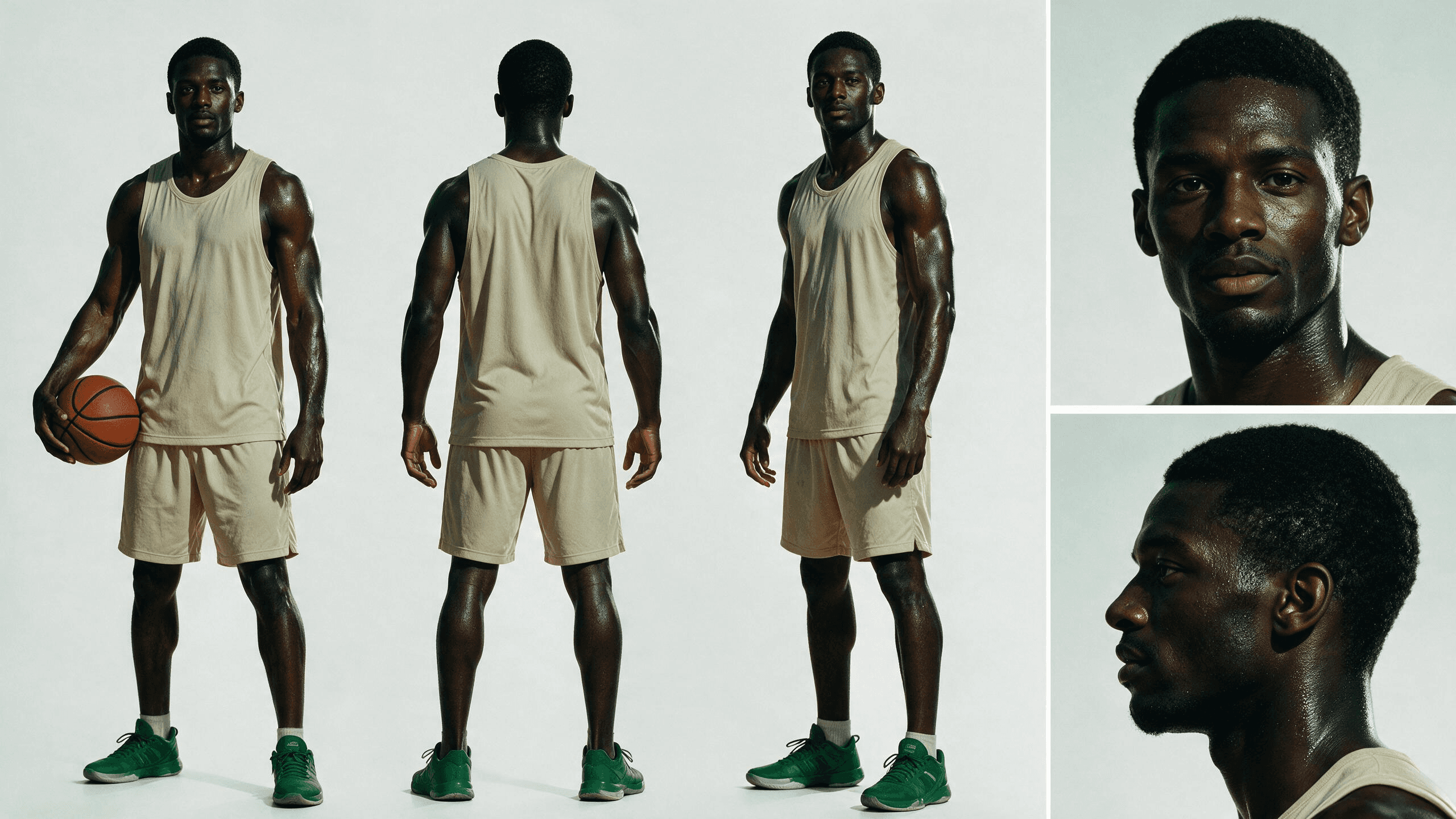
The characters. Two players, generated as stills first, with uniforms designed in the brand colours: one in plain cream with green shoes, one in dark green with white shoes, no logos, no numbers, nothing that dates or claims them. Each was then converted into a multi-angle character sheet, front, back, side and face close-ups, which is the step that makes consistency possible later. A single hero image tells the model what someone looks like from one angle; a character sheet tells it who they are.
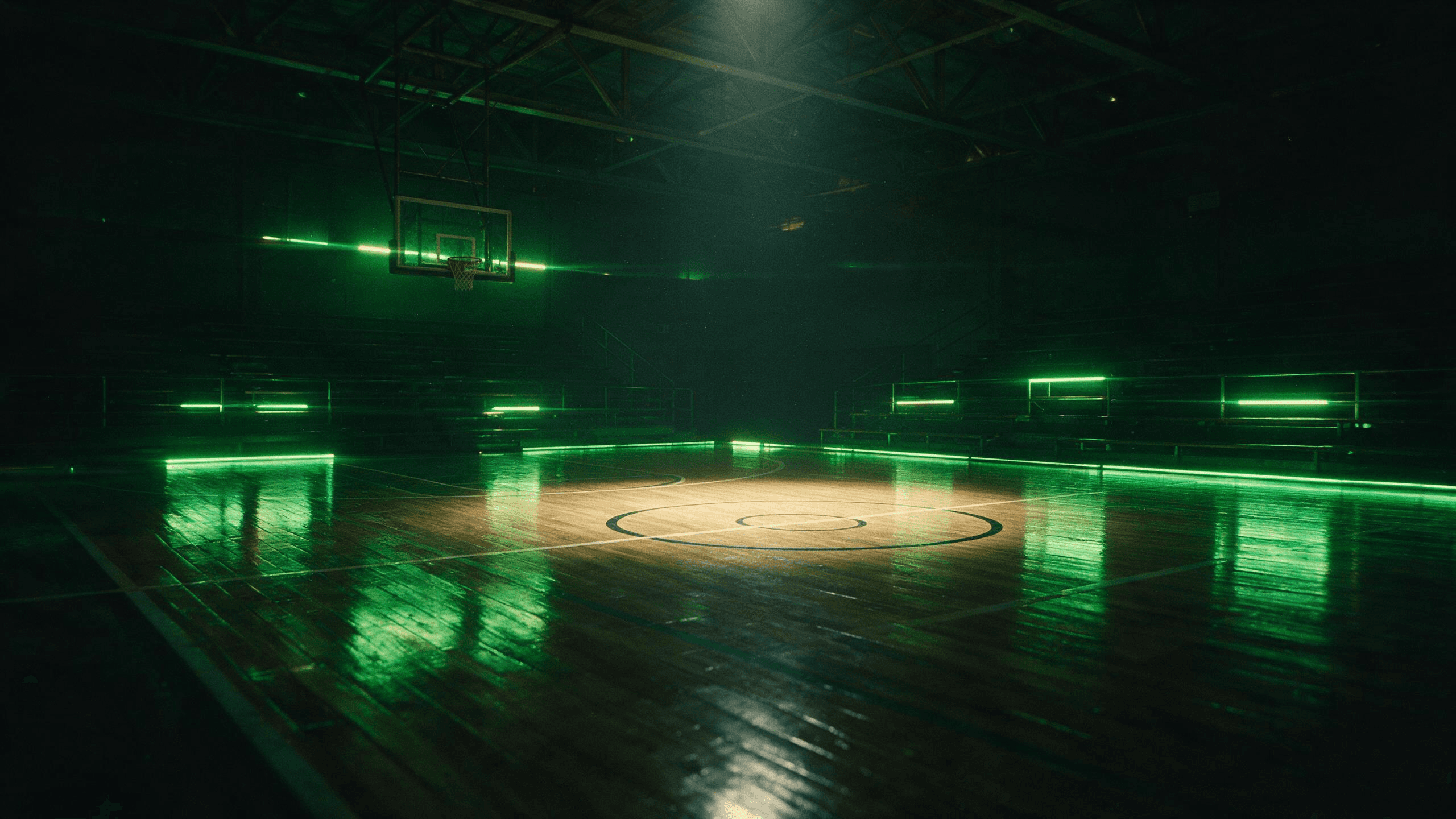
The environment. The court was generated separately, imagined through the brand's lens rather than found: polished hardwood, green neon tubing running the perimeter, dark empty bleachers, one warm pool of light at centre court. The arena is doing brand work, the palette is the identity, and the emptiness keeps every frame about the two players.
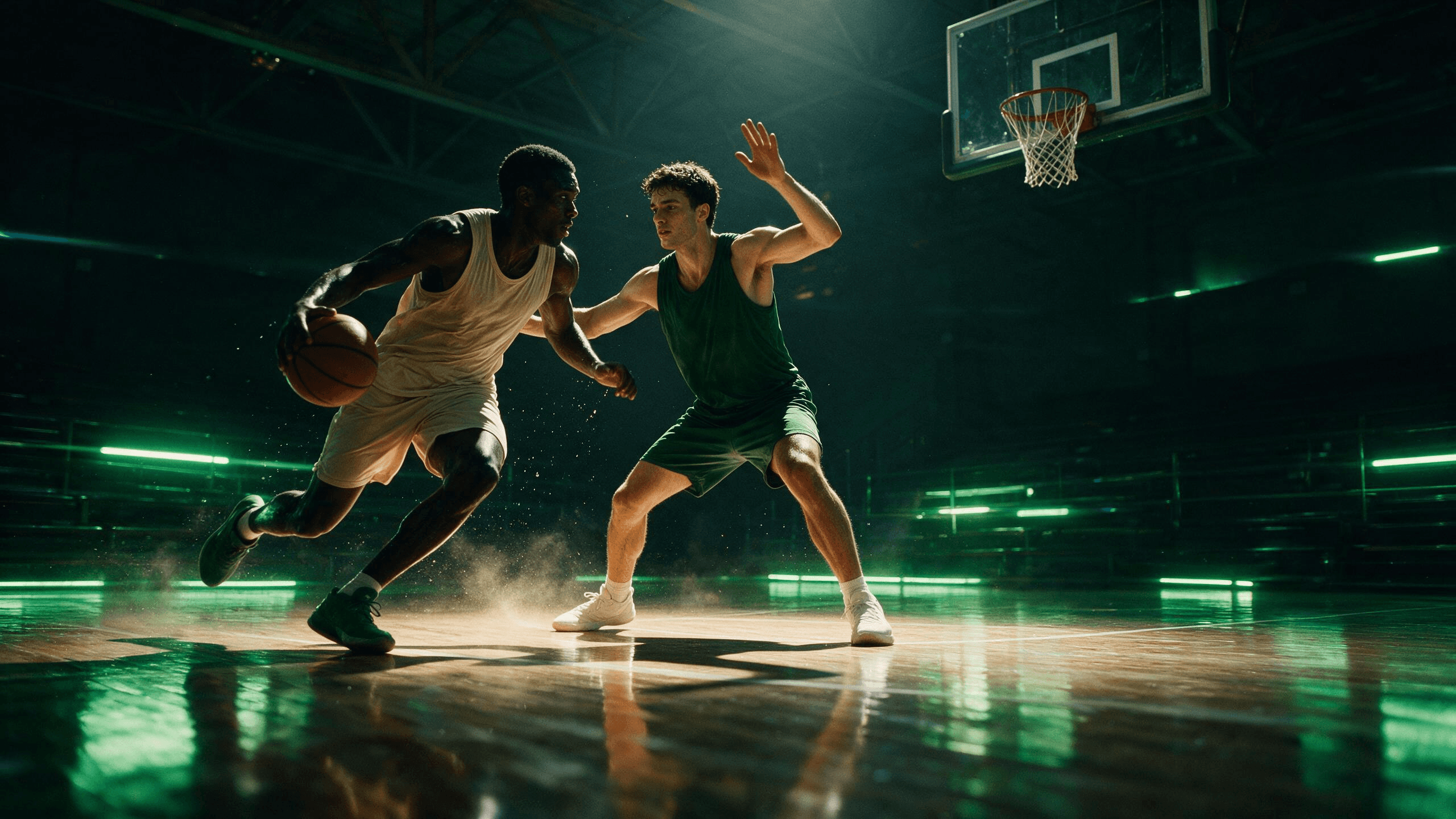
The key art. From the character sheets, I pulled the poses for a hero shot, the two players mid-contest under the neon, which became both the campaign-style key image and the opening frame of the video, so the motion begins exactly where the art direction ends.
The motion. A stock clip of a real street basketball game supplied the choreography and the camera: the drive past the defender, the rise into the jump shot, the handheld camera whipping up as the ball drops through the net. Only the movement transfers; none of the source clip's people, daylight or setting survives into the output. And the video reference is a choice, not a requirement, since the same shot can be directed through detailed written action alone. The reference simply gives you the precision of pointing at movement instead of describing it.
Then, and only then, the video generation, which at this point is less a creative act than an assembly of decisions already made. That inversion is the whole method: the direction happens before the model runs, so the model executes rather than improvises.
A system
The reason this matters commercially has little to do with any single output looking good. It is that the process is replicable. The same system, brief, characters, sheets, environment, key art, motion, generation, runs again for the next brand, the next campaign, the next format, and through the Claude skill I built around it, the consistency is carried by the system rather than by my memory of what worked last time.
It is also durable in a way that hosted tools cannot promise. The model runs locally, so even if the online platforms I use today disappear, the creative system survives on my own hardware, and better hardware simply makes it faster. Work built on a process outlives work built on a product.
And it does not need to be a fully synthetic process. The characters here were generated because this was a test, but the same pipeline accepts real people, photographed with proper authorisation, turned into character sheets with their real wardrobe and the campaign's costumes. It accepts 3D animation as the motion source, which I have run with Houdini setups, and it extends naturally into motion graphics. The hybrid version, real talent, designed environments, directed motion, is probably the more honest picture of where this sits in commercial production: not replacing a shoot, but extending what a brand can art-direct between shoots, before shoots, or where a shoot was never going to be affordable.
What the model contributes
What MiniMax H3 adds to this process, and the reason it anchors the pipeline, is fidelity. The play unfolds as written, the characters hold their identity through fast movement, the camera does what it was told, and the uniforms stay the colours the brand owns. Direction in, direction out. Fewer generations, no wasted ones, and a result that a client can sign off against the brief it came from, which is the only measure that matters.
The full technical breakdown, timings, platform comparison and install guide are in part 2, and the Claude skill that runs the pipeline is free on GitHub.
Start from a brand, not from a fantasy
Most AI video demos put someone in a fantastic situation, a superhero landing, a Transformers-scale set piece, something built to look cool for 6 seconds. That proves the model can render spectacle, and proves nothing about whether it can do a job, because commercial work rarely asks for spectacle. It asks for a perfume in the right light, a jacket on the right body, a sports brand's attitude held consistently across a campaign.
So I set the test up the way a real brief would arrive. I imagined a sports brand whose colours are green and beige, with a dark, cinematic atmosphere to its world, and wrote myself a short brief from that: a one-on-one basketball play, one continuous handheld shot, everything on screen speaking the brand's palette and mood. No brief, no shot. The constraint is the point, because a model that can only impress when it is unconstrained is a toy, and the question I am testing is whether this one takes direction.
Design every element before generating a single frame of video
The shot was built the way a production would be, as separate designed elements that come together, rather than as one lucky prompt.
The characters. Two players, generated as stills first, with uniforms designed in the brand colours: one in plain cream with green shoes, one in dark green with white shoes, no logos, no numbers, nothing that dates or claims them. Each was then converted into a multi-angle character sheet, front, back, side and face close-ups, which is the step that makes consistency possible later. A single hero image tells the model what someone looks like from one angle; a character sheet tells it who they are.
The environment. The court was generated separately, imagined through the brand's lens rather than found: polished hardwood, green neon tubing running the perimeter, dark empty bleachers, one warm pool of light at centre court. The arena is doing brand work, the palette is the identity, and the emptiness keeps every frame about the two players.
The key art. From the character sheets, I pulled the poses for a hero shot, the two players mid-contest under the neon, which became both the campaign-style key image and the opening frame of the video, so the motion begins exactly where the art direction ends.
The motion. A stock clip of a real street basketball game supplied the choreography and the camera: the drive past the defender, the rise into the jump shot, the handheld camera whipping up as the ball drops through the net. Only the movement transfers; none of the source clip's people, daylight or setting survives into the output. And the video reference is a choice, not a requirement, since the same shot can be directed through detailed written action alone. The reference simply gives you the precision of pointing at movement instead of describing it.
Then, and only then, the video generation, which at this point is less a creative act than an assembly of decisions already made. That inversion is the whole method: the direction happens before the model runs, so the model executes rather than improvises.
A system
The reason this matters commercially has little to do with any single output looking good. It is that the process is replicable. The same system, brief, characters, sheets, environment, key art, motion, generation, runs again for the next brand, the next campaign, the next format, and through the Claude skill I built around it, the consistency is carried by the system rather than by my memory of what worked last time.
It is also durable in a way that hosted tools cannot promise. The model runs locally, so even if the online platforms I use today disappear, the creative system survives on my own hardware, and better hardware simply makes it faster. Work built on a process outlives work built on a product.
And it does not need to be a fully synthetic process. The characters here were generated because this was a test, but the same pipeline accepts real people, photographed with proper authorisation, turned into character sheets with their real wardrobe and the campaign's costumes. It accepts 3D animation as the motion source, which I have run with Houdini setups, and it extends naturally into motion graphics. The hybrid version, real talent, designed environments, directed motion, is probably the more honest picture of where this sits in commercial production: not replacing a shoot, but extending what a brand can art-direct between shoots, before shoots, or where a shoot was never going to be affordable.
What the model contributes
What MiniMax H3 adds to this process, and the reason it anchors the pipeline, is fidelity. The play unfolds as written, the characters hold their identity through fast movement, the camera does what it was told, and the uniforms stay the colours the brand owns. Direction in, direction out. Fewer generations, no wasted ones, and a result that a client can sign off against the brief it came from, which is the only measure that matters.
The full technical breakdown, timings, platform comparison and install guide are in part 2, and the Claude skill that runs the pipeline is free on GitHub.

