Brand Systems
Client
Bally's Interactive x Hasbro
Timeframe
Under 5 weeks
Year
2024-2026
The situation
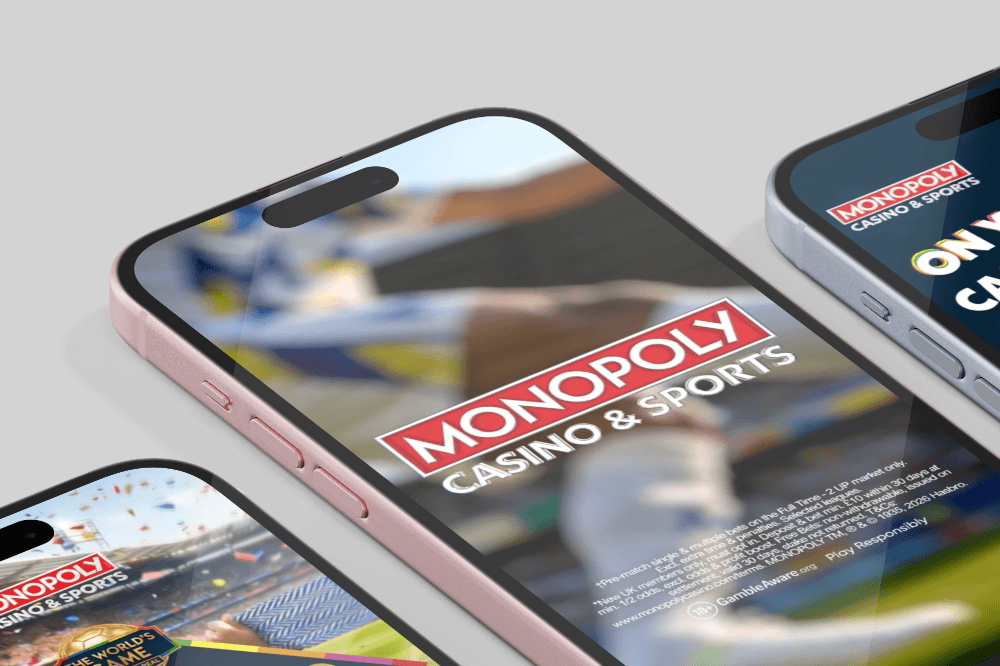
Bally's relaunched Monopoly Casino across the UK, US, Ireland and Spain: 4 markets, one licensed IP, and a brand partner in Hasbro with final say over how their property appears. The relaunch needed visual cohesion across every touchpoint, from CRM and app to paid media, out-of-home and the brand's first above-the-line YouTube campaign, delivered at speed and adapted for each market's regulatory and cultural context.
The trap in projects like this is delivering assets. Assets get used once. What the brand needed was a system.

What we built
I led the 3D and Motion team to design a modular brand motion system rather than a campaign:
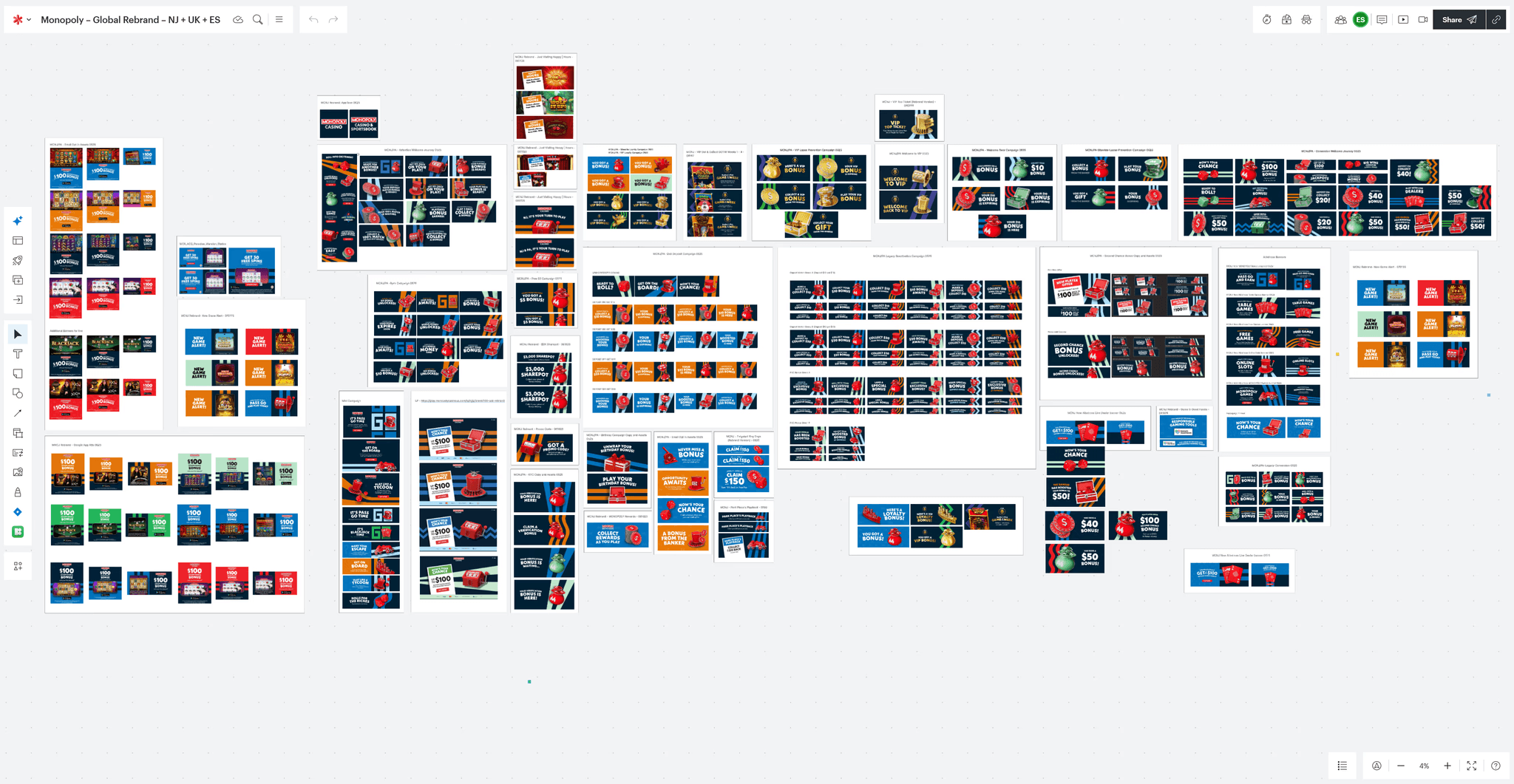
50+ original 3D icons, multiplied through colour, shader and style variations into a library of 400+ assets, all generated from the same system
A modular motion framework aligned with Google and Meta creative best practices, so every asset was born platform-ready
Localisation designed in, not bolted on. Brand, regulatory and localisation feedback was integrated at every stage, with market adaptation treated as a property of the system
That asset library then fed the campaign creatives across CRM, app, website, paid media, out-of-home and social: the channels drew from the system, rather than each channel commissioning its own artwork.
The scale was only possible because AI was part of the delivery from the start: a first set of icons was crafted manually in 3D, then used to train a model that generated the wider set on-brand, with every output finished by the team. The workflow itself is covered in the AI production case; here, it is what made 400+ assets in 4 weeks a realistic brief.
Delivery under constraint
The full asset library shipped in under 4 weeks. Every frame passed through legal and compliance review, and the licensed IP dimension meant Hasbro's standards applied on top of our own. One example of what that looks like in practice: for the Spanish market, a real identifiable landmark in the creative was replaced with brand-owned assets on IP grounds, the kind of adaptation that only surfaces when localisation and rights awareness are part of the design process rather than a late-stage check.
The result
Multi-market launch with unified branding across every touchpoint in the UK, US, Ireland and Spain
Campaign creative that proved roughly 4 times more cost-efficient at acquiring customers than the legacy assets it replaced
The brand's first above-the-line YouTube campaign launched on the same system
The system is still in use 2 years later. It generated the brand's World Cup campaign creative in 2026: 4 full creative sets across 2 brands, in every standard social aspect ratio, delivered in under 2 weeks, with the UK and Spanish market creatives produced hands-on by me. The creative direction followed a doctrine the wider team had drawn from earlier campaign measurement: narrative-led storytelling over product display, with brand and offer front-loaded
The World Cup work was also the first campaign for this brand to run fully integrated AI and VFX workflows on top of the system, blending AI-generated video with motion graphics under the hybrid approach covered in the AI production case
Early measurement of that campaign showed a significant brand lift across the creative variants, 2 years after the system it was built on shipped. Infrastructure, not a batch of deliverables


Why this case matters
Rebrands are usually judged on launch week. The better test is what exists 2 years later. A launch that still generates market-adapted campaign creative long after the original brief closed is proof of systems thinking: design decisions made once, upstream, that keep paying out downstream.
Discover other projects
Dive into our diverse collection of innovative projects, where creativity meets cutting-edge technology to solve real-world challenges